






What Does a Tissue Medium-Bag Packing Machine Really Cost? Reading Between Quotes
Two quotes land in your inbox the same week. Both claim a fully automatic facial tissue medium-bag packing machine, both claim "high speed," both look like the same machine in the photos. One is US$24,000. The other is US$38,000.
If you buy the first one, you may have saved $14,000. Or you may have bought a machine that runs 18 packs per minute instead of 30, needs a second operator, and stops production for four hours every time you change bag size.
This article is written for the buyer, not the seller: how a tissue medium-bag packing machine quote is actually built, which line items move the total price by thousands of dollars, what a realistic reference price looks like for a 28–30 pack/min dual-pusher machine, and how to calculate the payback before you sign.
Short answer: for a genuinely automatic facial tissue middle-bag packer in the 28–30 packs/min class, with servo dual-pusher stacking, dual-station bag magazine and S-type conveyor connection to your upstream line, expect a machine price in the low-to-mid US$20,000s at the factory gate — the published reference price for the ALX-300S-2 is around **US$24,000 for one unit**. The gap between quotes is not usually the machine; it is what surrounds it: tooling, integration, electrical standard, spares, and the terms behind the number. 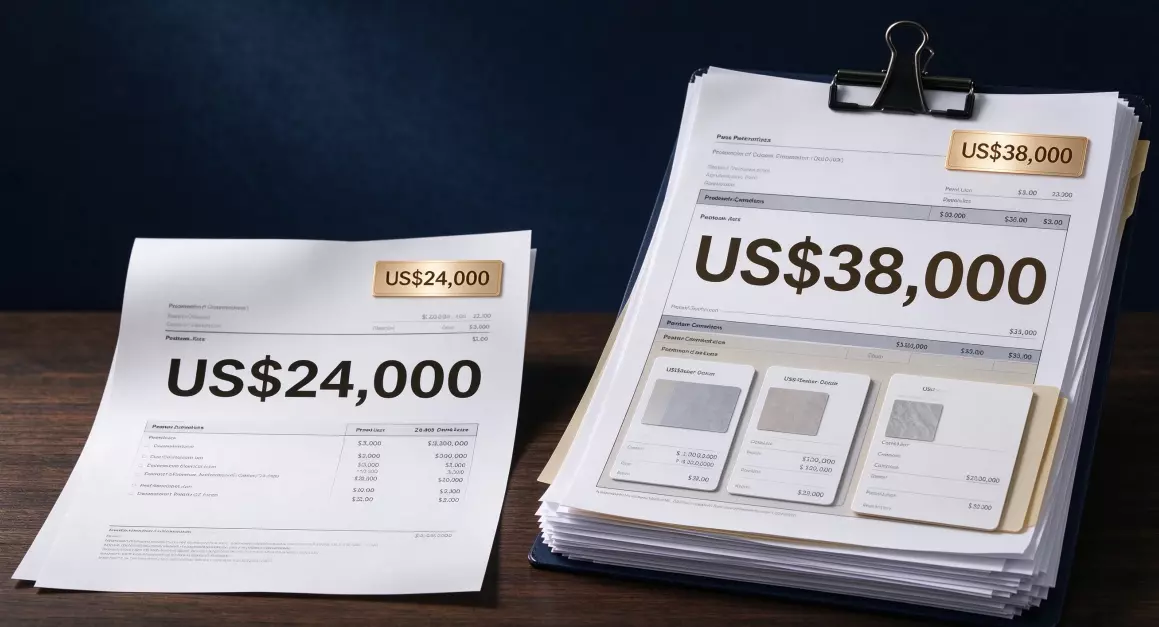
1. A Quote Is Not a Price. It Is a Scope.
The single most expensive mistake buyers make is comparing the bottom line instead of the scope. A packing machine quote is a bundle of nine items, and most suppliers only itemize four of them.
What a complete quote should break out:
- Base machine — the packer itself, with its standard configuration.
- Bag/pack format tooling — molds, forming components, and bag-size change parts for the sizes you actually sell.
- Upstream interface — the S-type chain conveyor, feeding unit, and control handshake with your existing single-pack tissue machine.
- Electrical and compliance standard — 380V/50Hz vs 220V/60Hz, CE vs local standard, motor brand tier, PLC and HMI brand.
- Spare parts kit — what ships with the machine and what you will need in month three.
- Packing, crating, and freight terms — EXW, FOB, or CIF; and whether crating is included or quoted separately.
- Installation, commissioning, and operator training — on-site or remote, how many days, whose cost.
- Warranty scope — parts only, or parts and labor; and the response-time commitment.
- Payment and delivery terms — deposit percentage, balance trigger, and lead time with a penalty clause or without one.
A quote that lists only items 1 and 6 is not cheaper. It is shorter. Everything else reappears later as an invoice, a delay, or a stopped line.
2. The Five Line Items That Move the Number Most
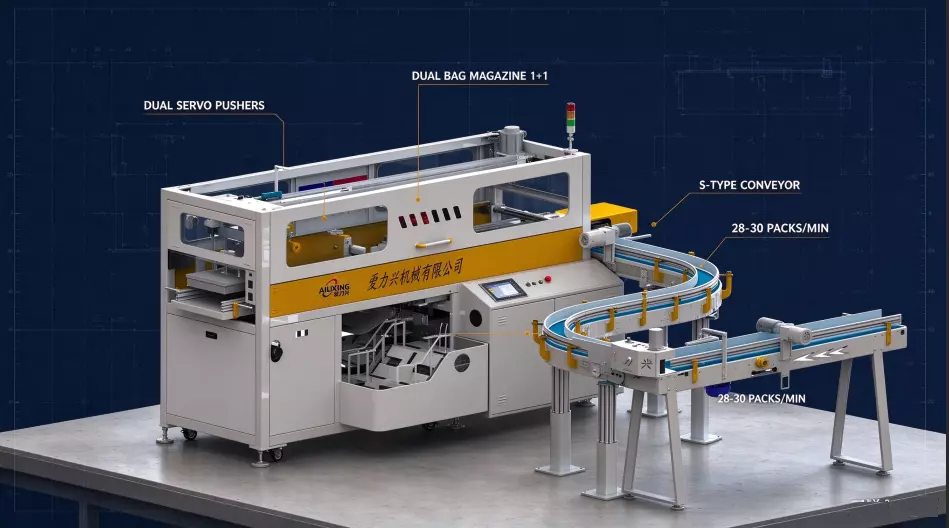
Servo count and pusher architecture. A single-pusher, cam-driven stacker and a dual independent servo pusher with vacuum corner folding are different machines that produce different bags. The dual-pusher design is what keeps soft-pack facial tissue from being crushed and keeps the fold clean during high-speed pushing. That is the difference between 30 packs/min of sellable product and 30 packs/min of product your QC rejects.
Bag magazine design. One bag magazine means the machine stops when the bags run out. A two-station magazine — one working, one standby, with photoelectric bag-level sensing and automatic switching — is the difference between continuous production and a stop every 20 minutes. Ask specifically: how many minutes of unattended running does the magazine give me, and does it switch automatically?
Stacking and counting control. Servo two-stage stacking with layer count set on the touchscreen lets you change from 6-pack to 10-pack by recipe instead of by wrench. Cam-based fixed counting means a mold change for every new pack count.
Electrical and drive tier. The same frame can be built with premium servo drives or budget ones. This is invisible in a photo and very visible in year two.
Integration scope. If the machine has to connect to your existing facial tissue line, the S-type conveyor, product-orienting feeder, and the Ethernet handshake for data acquisition are real engineering, not accessories. A supplier who quotes "machine only" and leaves you to build the interface is handing you a project.
3. Reference Point: What a 28–30 Pack/Min Machine Actually Specifies
Numbers are the only antidote to sales language. Here is a real, published specification set for a dual-pusher facial tissue middle-bag packer in this class — the ALX-300S-2 from Dongguan Ailixing Machinery:
| Item | Specification |
|---|---|
| Designed speed | 35 packs/min |
| Actual working speed | 28–30 packs/min (depending on tissue specification) |
| Stacking | Servo-driven two-stage, layer count set on HMI |
| Bag feed | Dual-station magazine (1 working + 1 standby), photoelectric level sensing, auto switching, brush + air-blow anti-double-pick |
| Upstream connection | S-type chain conveyor, seamless link to single-pack facial tissue machine, dedicated Ethernet port |
| Total motor power | 22 kW (heating 1.6 kW) |
| Air consumption | 0.45 m³/min @ 0.6 MPa |
| Finished pack size | L 120–550 mm, W 120–400 mm, H 80–115 mm |
| Qualification rate | ≥98% |
| Noise | ≤75 dB |
| Machine dimensions | L 3227 × W 1560 × H 1480 mm |
| Weight | 1200 kg |
| Power supply | AC 380V, 50Hz |
| HS code | 8422309090 |
three things to do with this table.
First, check the gap between designed and actual speed. "35 packs/min designed, 28–30 actual" is an honest pair of numbers. A quote that states only one number is telling you half the truth — always ask for the sustained figure at your tissue weight and fold height.
Second, check your product against the size range. If your medium bag falls outside L 120–550 / W 120–400 / H 80–115 mm, the price changes, and it changes before you sign, not after.
Third, check the ≥98% qualification rate against what you can sell. At 30 packs/min, 2% rejects is 36 packs per hour you paid film, tissue, labor and power for and cannot ship.
4. The Purchase Order Is Roughly Half the Cost
This is the part that most buyers never model, and it is where the cheap machine becomes expensive.
Film. Film is the largest recurring cost per pack, and it is the easiest cost to hide. Two machines that both claim "PE film" can differ materially in film consumption per 100 packs because of forming efficiency, bag size fit, and trim waste. Do not accept a datasheet number. Ask for measured film consumption during the acceptance run, at your bag size, and write it into the contract as a line item.
Power and air. At 22 kW plus 0.45 m³/min of compressed air, energy is a real per-hour number in a two- or three-shift plant. Compare it against the machine you are replacing, not against zero.
Labor. This is the line item that actually justifies the investment. A manual medium-bag operation typically needs several people per shift on counting, bagging, sealing and cartoning. An automatic packer collapses that to one operator supervising the line — and the saving multiplies across every shift you run.
Spares and downtime. A $300 sensor that takes eight weeks to arrive has a carrying cost far above $300. Ask for the recommended two-year spare parts list with unit prices, and ask how many of those parts are standard third-party components available locally.
Changeover time. If switching from a 6-pack to a 10-pack bag costs half a shift, you will not take the small orders — and small orders are how most tissue plants enter new markets.
A payback illustration, with the assumptions stated. Take a plant running two 8-hour shifts, 26 days a month, replacing four manual packers at an assumed US$400/month each:
- Labor saving: 4 × $400 × 12 = **$19,200/year**
- Machine + tooling + freight + commissioning, budgeted: ≈$30,000
- Simple payback on labor alone: ~19 months
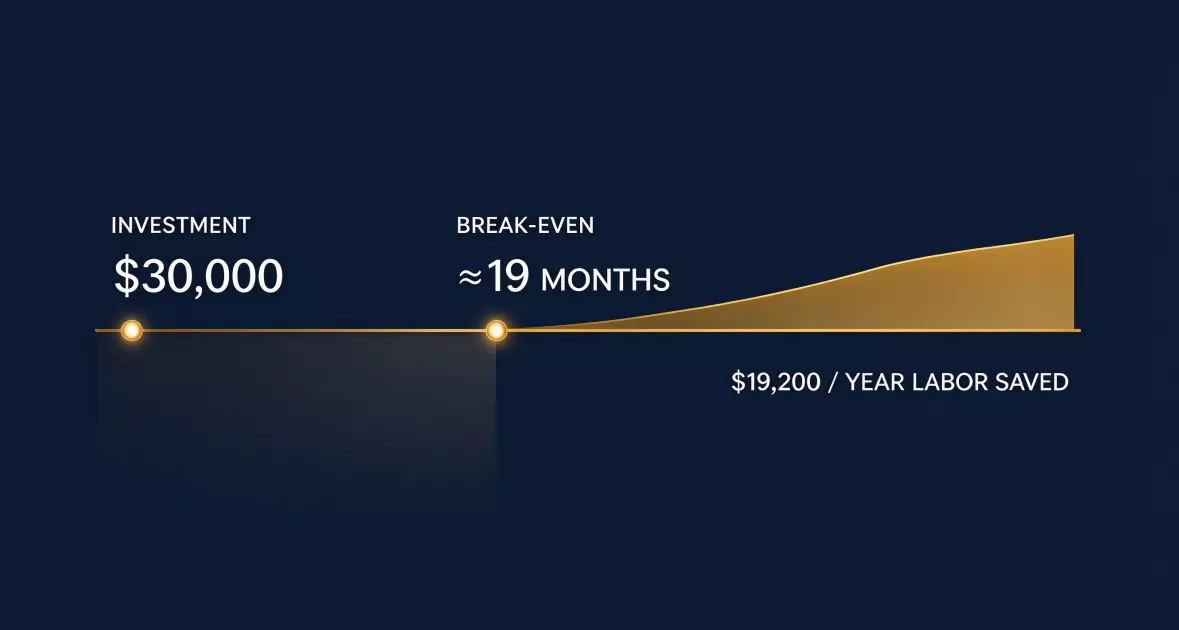
Add film savings from tighter forming, plus the 2% of output no longer lost to rejects, plus the orders you can now accept because changeover is fast — and the real payback is typically shorter. Change the wage assumption to your own market and the model still holds; the point is that the machine is justified by throughput and labor, not by the discount you negotiated.
5. When Two Quotes Differ by 30%, Ask These Seven Questions
- What is the sustained speed at my tissue weight, fold height and bag size — and will you write it into the contract with a penalty?
- How many servo axes does the machine have, and which axes are servo versus cam-driven?
- Does the bag magazine switch automatically, and how many minutes of unattended running does it provide?
- Is the S-type conveyor and upstream handshake included, or quoted separately?
- What is the qualification rate you guarantee at acceptance, and how is a reject defined?
- What is your spare parts lead time for the ten most-consumed parts, in writing?
- What happens if commissioning is late — is there a delay clause?
A supplier who answers all seven in writing is not necessarily the cheapest. They are the one whose price you can actually compare.
6. Red Flags in a Quote That Looks Too Good
- One speed number, no sustained figure. Designed speed sold as real speed.
- "Tooling included" without a mold list. You will discover which sizes are missing at your first format change.
- No electrical standard specified. 380V/50Hz versus your plant's supply is a commissioning-day problem, not a paperwork problem.
- No acceptance criteria. Without a defined acceptance run — speed, qualification rate, film consumption, pack dimension — "it works" is the only warranty you have.
- No named spare parts list. The cheapest machine is the one you can keep running.
- Photos instead of a factory acceptance video at your bag size. Ask for the machine running your format, filmed end to end.


7. How to Build a Quote You Can Actually Compare
Send every candidate supplier the same one-page brief:
- Your tissue type, weight, fold height, and single-pack dimensions
- Your medium-bag format: packs per bag, bag dimensions, film type and thickness
- Upstream equipment make and model, and the connection you need
- Your plant voltage, frequency, and required certification
- Your required sustained output per shift, and your target changeover time
- Required Incoterm, destination port, and installation expectation
- Required spare parts list and warranty response time
Identical briefs produce comparable numbers. That is the whole trick: you cannot read between quotes until the quotes describe the same machine.
8. FAQ
How much does a tissue medium-bag packing machine cost?
For an automatic dual-pusher facial tissue middle-bag packer in the 28–30 packs/min class, the published reference price for the ALX-300S-2 is around US$24,000 per unit at the factory gate. Delivered and commissioned cost in your plant typically lands meaningfully higher once tooling, crating, freight, electrical adaptation and installation are included — which is exactly why the itemized quote matters more than the headline price.
What is the payback period?
On labor replacement alone, most two-shift operations see payback in roughly 18–24 months, before film savings and reject reduction. Model it with your own wages, shifts and reject rate.
Can it connect to my existing facial tissue line?
Yes, when the machine is specified with an S-type chain conveyor and a control handshake. This must be in the quote, not added later.
What bag sizes can it run?
On the ALX-300S-2, finished packs from L 120–550 mm, W 120–400 mm, H 80–115 mm. Confirm your format against this range before negotiating price.
Is a cheaper machine a bad machine?
Not necessarily — but a cheaper machine is usually a smaller scope. The question is never "which is cheaper," it is "which quote describes the machine I need, at a speed I can sell."
The Bottom Line
A tissue medium-bag packing machine is not priced by the kilogram of steel. It is priced by servo axes, bag-magazine design, integration scope, compliance standard, and the willingness of the supplier to put sustained speed and qualification rate in writing. Read the line items, model the film and labor, and demand an acceptance run at your own bag size — then the number at the bottom of the page finally means something.
Next: No More
