






How to Choose the Right Tissue Paper Production Line?
How to Choose the Right Tissue Paper Production Line?
Consider the following core dimensions:
Step 1: Clarify Core Needs and Positioning
Before contacting any manufacturer, think clearly about these questions, as they will directly determine your choice:
① Production Scale: Are you a family workshop, a small processing plant, or planning large-scale production? Scale determines the equipment's capacity and automation level, directly impacting the budget.
② Target Products: Do you mainly produce toilet paper, facial tissues, napkins, or kitchen paper? Different products require vastly different production line configurations and specialized equipment.
③ Budget Range: What is your total investment budget? (This must include equipment, factory space, raw materials, labor, etc.) | Equipment prices range from tens of thousands to hundreds of thousands or even millions; you need to calculate the "total cost" rather than just looking at the equipment's listed price.
④ Market Positioning: Do you primarily target the low-end wholesale market, or pursue a high-quality, differentiated (e.g., embossed, printed) high-end market? Positioning determines the required functions and precision of the equipment.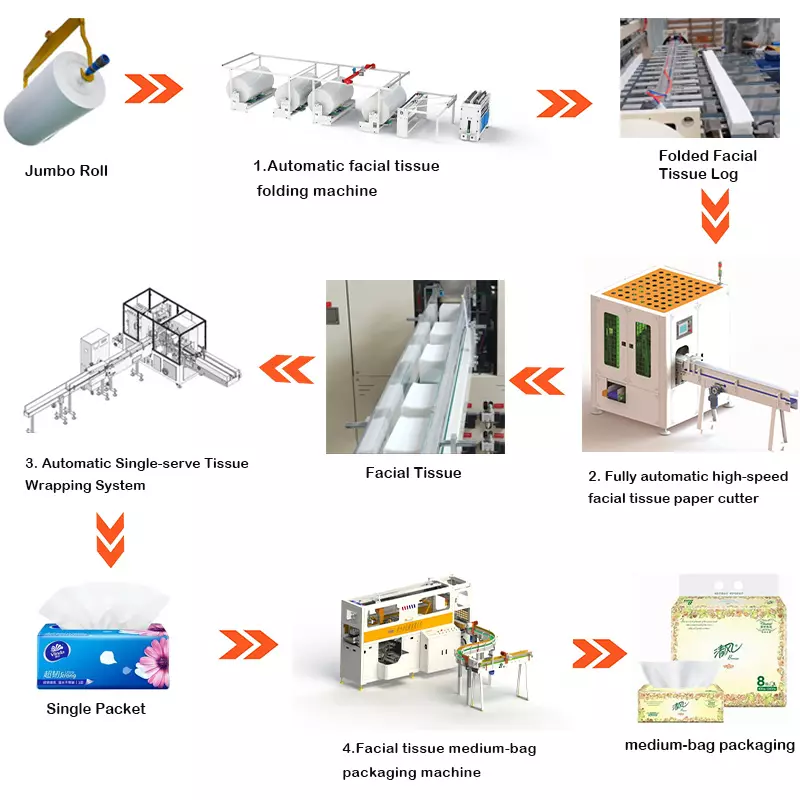
Step Two: Understanding Key Considerations
After clarifying your needs, you can evaluate and select equipment based on the following key points:
1. Capacity and Efficiency: Can it meet your order volume?
Look at output: Equipment capacity is usually measured in "minutes/meter" or "hours/ton." For example, a small machine might produce about 2 tons in 8 hours, while a fully automated production line can produce 5-6 tons or more in 8 hours. Work backward from your target daily output to determine the required speed.
Look at automation: Fully automated production lines require only 1-2 operators, significantly reducing labor costs and human error; semi-automatic equipment requires more human intervention, but the initial investment is smaller.
2. Functionality and Flexibility: Can it produce competitive products?
Raw Material Adaptability: Can your production line handle various raw materials such as bamboo pulp, sugarcane pulp, and recycled paper? This directly impacts your cost control.
Product Diversification: Does it have functions such as embossing (increasing softness and aesthetics), printing (personalized customization), and quick changeover (adapting to small-batch, multi-variety orders)? This is crucial in a highly competitive market.
3. Reliability and Cost: Is it worthwhile in the long run?
Energy Consumption: Excellent equipment can reduce energy consumption by 12%-15%, which is a significant saving in the long run. Pay attention to the energy efficiency rating of the motor and the design of the drying system.
Stability and Precision: Do core components (such as servo motors and PLC controllers) use well-known brands (such as Siemens and ABB)? This determines the equipment's failure rate and packaging accuracy (e.g., 0.1 mm).
Materials and Lifespan: Is the machine body made of stainless steel or ordinary steel? Durability directly affects the equipment's lifespan and maintenance costs.
4. Service and Guarantee: Can subsequent production proceed without worry?
After-sales Response: What is the manufacturer's promised fault response time (e.g., 24 hours/48 hours)? Is remote guidance provided? Is there sufficient inventory of vulnerable parts?
Technical Support: Does the manufacturer provide a "turnkey" service from factory planning, installation and commissioning to personnel training? This is especially important for novice investors.
Hopefully, this guide will help you clarify your thinking. If you already have a preliminary idea of where you want to go, feel free to contact me!
Previous: How to choose a toilet paper production line
Next: How to Choose the Right Automatic Toilet Roll Packaging Machine for Your Tissue Mill
